ARTISTS: Pary El-Qalqili & Marta Popivoda, Basyma Saad (& Sanja Grozdanić)
CURATORS: Što, kako i za koga / WHW & Ana Kovačić
Wednesday, 27/05/ 2026
Talk with Pary El-Qalqili, Marta Popivoda, Basyma Saad
Moderated by Kate Sutton
19 h
Opening of the exhibition
20 h
Opening hours:
Tue–Fri: 4pm – 8pm
Sat: 11am – 3pm
Exhibition is open until 06/06/2026
In 1968, Diane di Prima started writing what would become her Revolutionary Letters. The writer and activist would read these poems-as-letters in public, passing them out as stapled pamphlets on the streets of San Francisco and disseminating them through a network of underground newspapers across the United States. Her message was clear: any true revolution must start with the means at hand. As she admits in her Revolutionary Letter #1:
I have just realized that the stakes are myself
I have no other
ransom money, nothing to break or barter but my life
my spirit measured out, in bits, spread over
the roulette table…
The poet goes on to describe trying to play by the system’s rules, “stepping always/ (we hope) between the lines.” With a shift of parentheses, this exhibition takes a new spin on di Prima’s closing line, as it examines how shared grief can also provide a source of hope, a means of forging the cross-national collective needed to build a more equitable and just society.
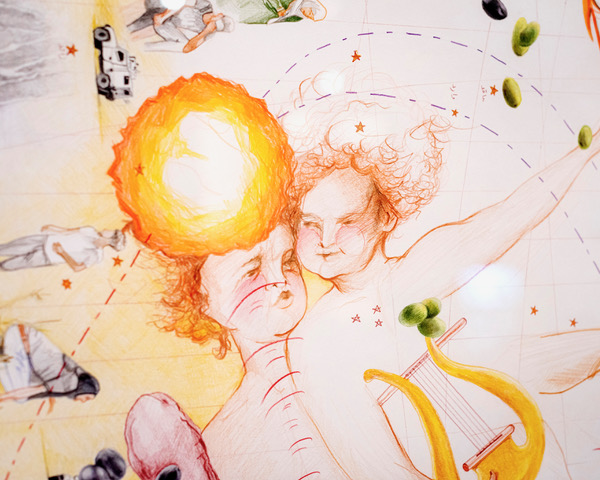
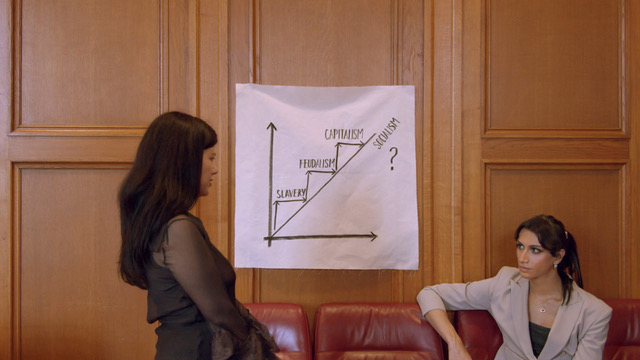
First, however, one must bury the old. Sanja Grozdanić and Basyma Saad’s Permanent Trespass, sets out to do just this, with the help of a pair of professional mourners (self-described “traveling eulogists”.) Conceived as a memorial for the American Century – a concept that is not tied so much to a specific geography as an ideology built on extraction and accumulation – the film is set within an imagined amalgam of several Art Nouveau villas in Belgium. Wonders of architectural heritage, these stunning interiors were financed with plunder from the Congo, violence reborn as an “organic”-minded opulence. Within the film, these trophy interiors are now host to an estate sale.
A eulogy is supposed to bring with it finality, but here the idea of professionalized grief strips mourning of its intimacy and uniqueness. Instead, it “returns death to the market,” offering just another product for consumption. Footage glitches and doubles back on itself, while visible scripts emphasize the film as a rehearsal for a ceremony that can be performed again and again, with just the names and dates swapped out. The two eulogists are periodically interrupted by what the artists call a “cine-poem”, a disembodied voice that rattles off the keywords that have helped prop up Western hegemonies – “Nakba”, “North Atlantic”, “Preventative Defense” – fragments of phrases that conjure up entire histories of violence and dispossession.
Amidst this “Clearance Sale on Language Itself”, the artists glide from Palestine to the “Beirut of the Balkans,” drawing correspondence between conflicts across continents. The camera lingers on displays of artifacts for the International Criminal Tribunal for the former Yugoslavia (judges robes, gavels, various memorial plaques, etc), in a pantomime of what we can expect from “justice”, as the artists cite a saying that then-president Barack Obama had added to a carpet in the Oval Office: “The arc of the moral universe is long, but it bends towards justice.” Misattributed to Martin Luther King, Jr, this quote from abolitionist Thomas Parker, when stripped of its context, offers a convenient acquiescence to one’s circumstances, a sidestepping of accountability, embroidered with optimism that the “eventual” will save us. No wonder the words must go.
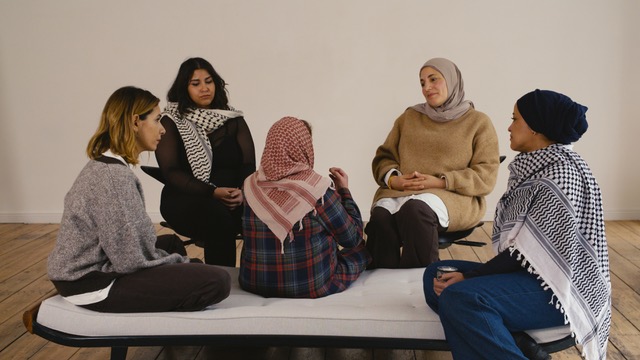
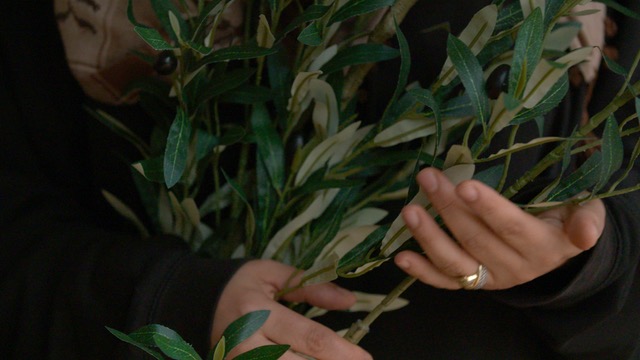
Marta Popivoda and Pary El-Qalqili’s ICH BIN HIER, ICH BIN DA, 2025, finds ways to communicate without language. The film opens with a wordless introduction to its cast of women, whose expressions alone speak volumes. All Palestinian and living in Berlin, where public displays of solidarity with their country of origin has been effectively criminalized, the women gradually open up to share their experiences of life “between the lines.” This specific bilocation is hinted at by the title, which translates roughly to “I am here, I am there.” Eyes mist with tears as the women discuss the atrocities in Gaza, the attack on Al Shifa hospital, or the force inflicted on them or their children while attending rallies in Berlin. Families are acknowledged as potential weaknesses, pressure points to be exploited by the police, but these women turn them into strength, reifying that it is because of their children that they must stand strong. One woman recalls the pride she felt for one of her daughters who was taken into custody at a protest, while another dreams of moving with her children to Palestine, where she herself has never been, so they can live peacefully among the olive trees.
These testimonies waver between desolation and hope. With nothing to barter but their lives, these women view taking to the streets in protest as an act of collective grief—one of the only acts available to them. The rallies allow them build the kind of communities and solidarities they have otherwise been denied. “Silence was never an option for me,” one woman confirms. “Silence would have killed me.”
By bringing together these two projects, We Hope (Between the Lines): The Yearning of the Conspirator highlights commonalities between the former Yugoslavia and the Middle East, positing the shared experiences of violence and grief as a starting part for new solidarities and collaborations.
Kate Sutton
ARTISTS’ BIOGRAPHIES
Pary El-Qalqili is based in Berlin, where she works in the fields of film, performance, and teaching. In her work, she explores experiences of flight, exile, violent power dynamics, and resistance. She uses colonial imagery, regimes of the gaze, and hegemonic visual politics as a starting point to examine processes of dehumanization and erasure. In her cinematic work, she seeks narrative forms that allow for gaps, breaks, and disruptions. She is currently working on the long-term project “Unruly Archive,” which explores Palestinian history in Germany through film, performance, and archiving. Since 2020, she has taught courses on feminist and decolonial cinema, theory, and practice at the Berlin University of the Arts, the Barenboim Said Academy, Johannes Gutenberg University Mainz, the Braunschweig University of Art, and the self-organized film school filmArche. In 2024, she co-founded the Palestinian Feminist Archive Berlin. In 2026, she is developing the exhibition “How Do We Unlearn Obedience?” together with İz Öztat, which will be shown at Galerie Nord in Berlin.
Marta Popivoda is a filmmaker, artist, and researcher. The main concerns in her work are the tensions between memory, history, and ideology, as well as the relations between collective and individual bodies. Popivoda approaches them from a feminist and queer perspective. In her recent work, she uses landscape dramaturgy, feminist storytelling, and principles of radical slowness to produce scenes of antifascist and eco-feminist memory. Her work has been presented worldwide in the cinema and visual arts contexts, such as Berlinale, Locarno, IFFR, NYFF, IDFA, MoMA New York, Tate Modern London, MAXXI Rome, Manifesta Biennial, Berlin Biennale, etc., and featured in the Guardian, Sight & Sound, Screen, Artforum, and e-flux. She received numerous awards for her films and artwork, including the prestigious Berlin Art Prize for the Visual Arts at the Akademie der Künste Berlin. She teaches film at the University of the Arts in Amsterdam and is a member of the European Film Academy.
Basyma Saad is an artist and writer born in Beirut. Through film, performance, and sculpture, as well as essays and fiction, she explores notions of mourning, spontaneity, and surplus. With dark humor and an emphasis on forms of struggle, her work places scenes of intersubjective exchange within their historical frameworks. Basyma’s work has been presented and screened at the Museum of Modern Art (New York), The Poetry Project (New York), CPH:DOX (Copenhagen), Triangle-Asterides (Marseille), Swiss Institute (Rome), Ludwig Forum (Aachen), Cabaret Voltaire (Zurich), the Busan Biennale, and Transmediale. Her most recent film, Congress of Idling Persons (2021), received Special Mention in the New:Vision Award category at CPH:DOX 2022. She is currently working on a new film titled Permanent Trespass, based on a theater script of the same name, with Sanja Grozdanić. Her writing appears in n+1, The New Inquiry, Protean, Spike Art, Jadaliyya, FailedArchitecture, X-TRA, and The Funambulist.
The exhibition operates under the larger umbrella of WHW’s discursive framework, Remember Freedom. Launched in 2025, this initiative draws its inspiration from a 2014 speech in which Ursula LeGuin urged society to tend to its artists—“the realists of a larger reality.”
Exhibition is open until 06/06/2026
Opening hours:
Tue–Fri: 4pm – 8pm
Sat: 11am – 3pm
Supported by:
City Office for Culture and Civil Society of the City of Zagreb
Foundation Kultura Nova
Ministry of Culture and Media of the Republic of Croatia